John and I both needed a little normalcy this week. Going forward, I think we’re going to try to make Friday nights our time to get out of the house, go somewhere, and remember that our lives are still bigger than doctors, appointments, medications, and speech therapy.
This Friday, we headed to the North Shore.
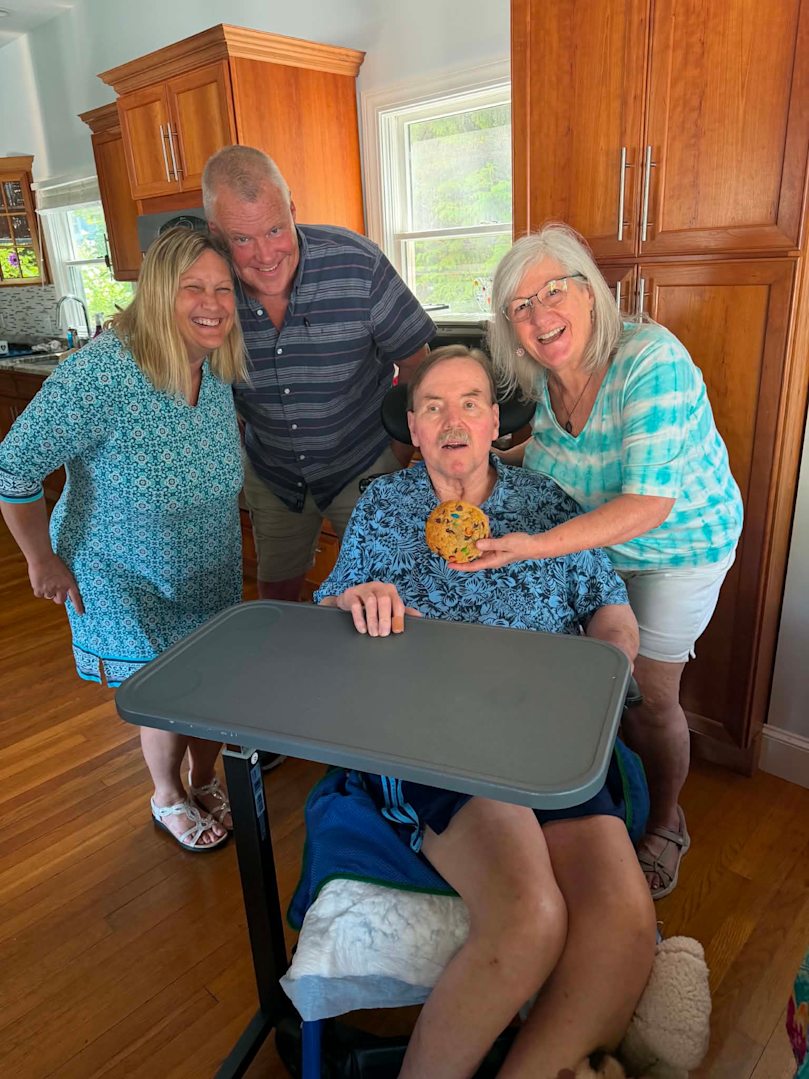
Our first stop was to visit our friends Pam and Bob. Bob has Lewy body dementia and Parkinson’s, so they understand better than most how suddenly life can change. We brought them lunch—delicious sandwiches from the Manhattan Sandwich Company in Marblehead—and spent some time together.
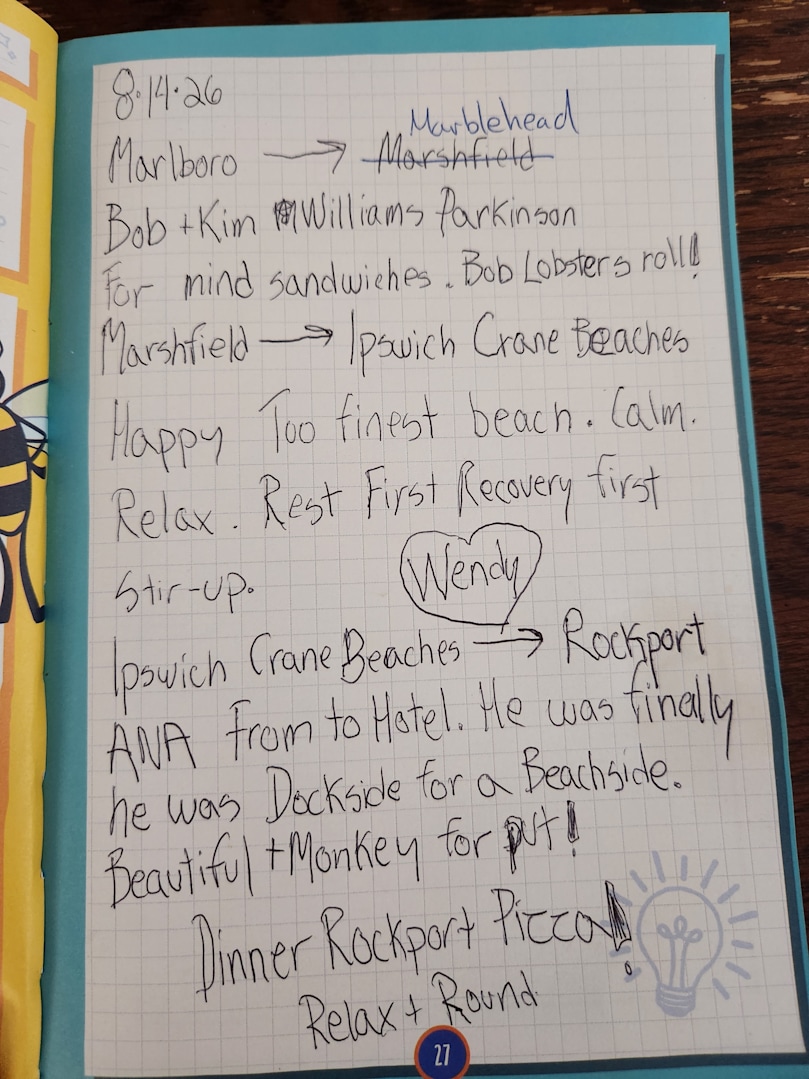
Then we continued on to Rockport.

Rockport has always been special to us. Eighteen years ago, John asked me to marry him on a jetty at Bearskin Neck. This time, we stayed overnight at a little Airbnb near Front Beach.
We walked down to the beach, swam out to the floating dock, lay in the sun, and jumped off into the water. For a little while, it felt wonderfully normal.

We had planned to have dinner at Feather & Wedge, a restaurant we’d gone to a couple of years ago for my birthday. John had actually spent part of his speech therapy session on Thursday preparing for it. He pulled up the menu online, wrote down all the things he wanted to eat, and practiced with his therapist how he could point to what he wanted.
He was so excited about going.
But by dinnertime, his brain was done.
One of the things we’re learning is how quickly John’s brain can become exhausted by activity. Despite how much he’d been looking forward to the restaurant, he realized he simply couldn’t do it.
So we got takeout pizza and ate it on the back deck.
And honestly, it was perfect.
The next morning, we went to Crane Beach and ate our leftover cold pizza for lunch. A seagull swooped down, snatched John’s slice directly out of his hand, landed about 30 feet in front of us, and proceeded to eat it while staring at us.
So apparently even after a massive stroke, you can still get mugged by a seagull.
The Part the Pictures Don’t Show
I want to share something less cheerful, because I worry that my positive updates sometimes unintentionally gloss over the reality of where John’s brain is right now.
John has an invisible injury.
You can look at pictures of him swimming, sitting on a beach, smiling, or walking around Rockport and think, He looks great.
And physically, he does.
But the pictures don’t show what is happening inside his brain.
Today we worked on his speech therapy homework using an iPad app called Comprehension Therapy.
In the first exercise, the app spoke a word and John had to identify the corresponding written word on the screen. On the hard level, he scored 21 out of 25 — 84%. I’ve included a picture of the exercise and his results below.
That is progress, and we celebrate it.
Then we moved to something considerably harder.
The app spoke a verb, and John had to choose the picture showing that action from six possibilities. If he couldn’t understand the spoken word, he could ask for a hint, which showed him the written word while saying it again.
On that exercise, John scored 11 out of 25 — 44%.
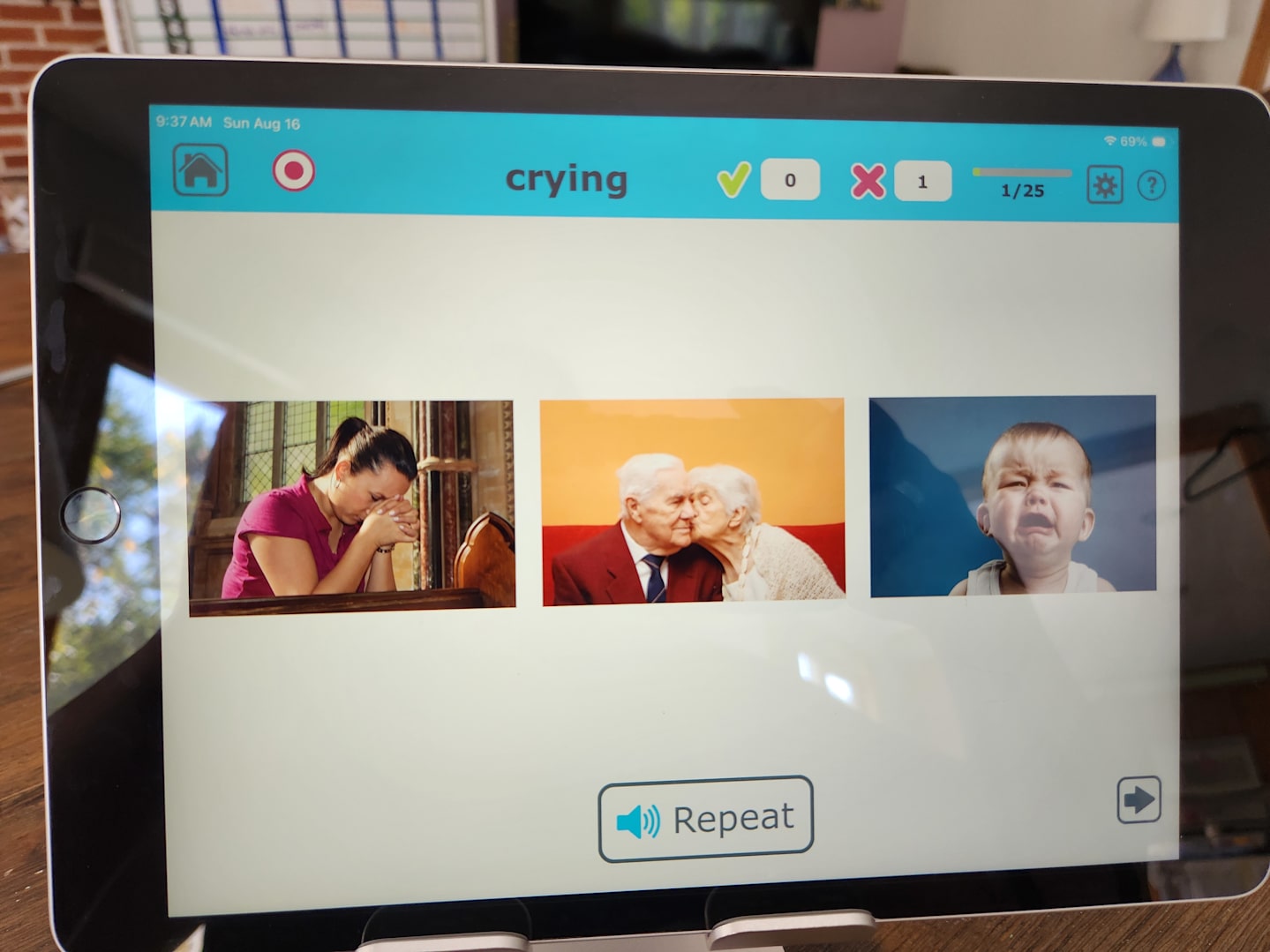
He needed hints for words including crying, feeding, smiling, kicking, digging, coaching, calling, blowing, diving, tearing, and burning. Sometimes he understood the general concept but selected a related action—for example, drawing instead of painting or helping instead of giving.
Then we tried an exercise that showed a picture—in this case, a donkey—and asked John to write things describing it.
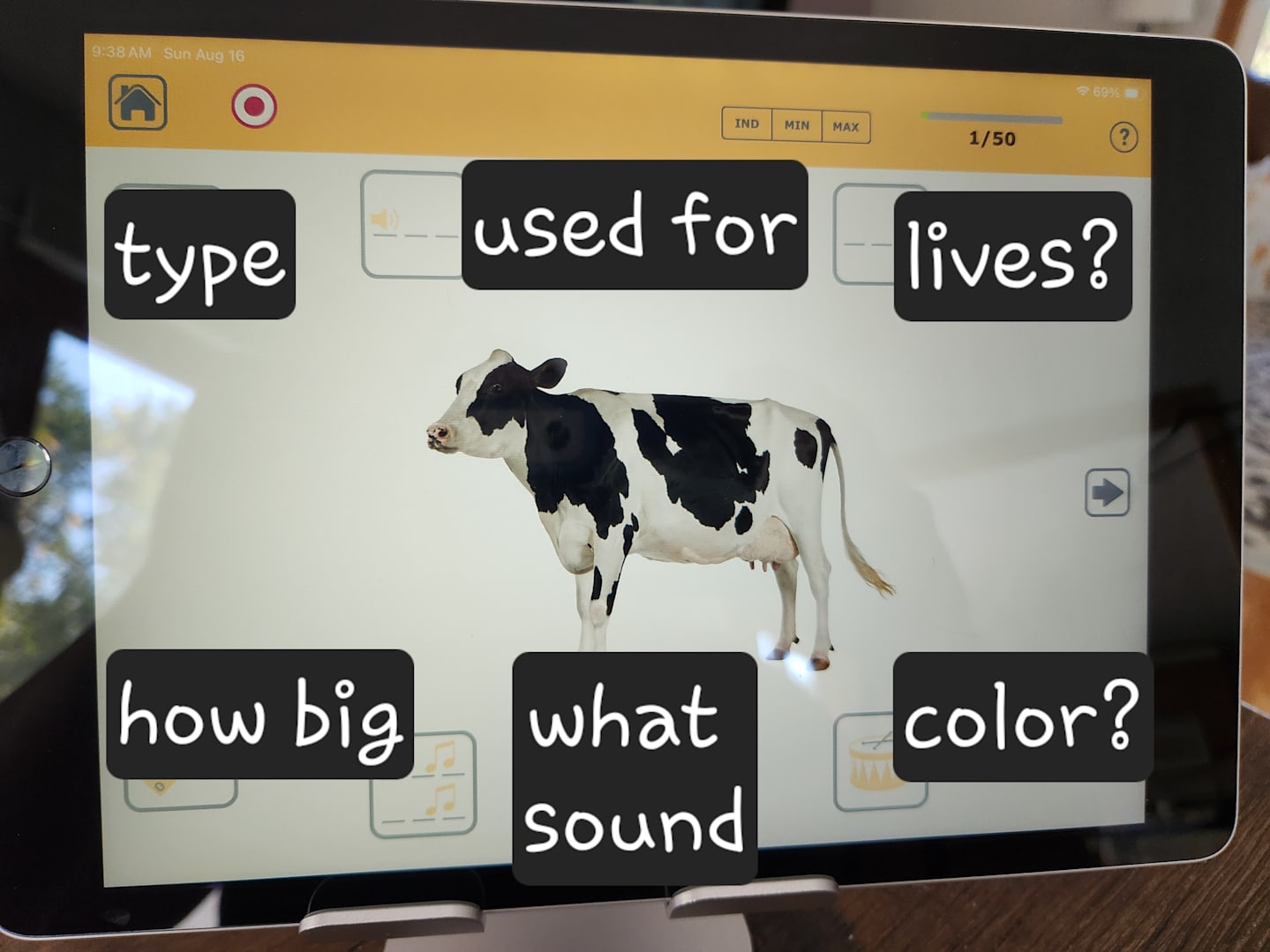
He couldn’t do it.
It was simply too difficult, and eventually it brought him to tears. So we stopped.
We switched to his aphasia workbook. This exercise gave him categories and asked him to write anything he could think of belonging to each one. Today’s categories included American cities, sports, movies, and types of fish.
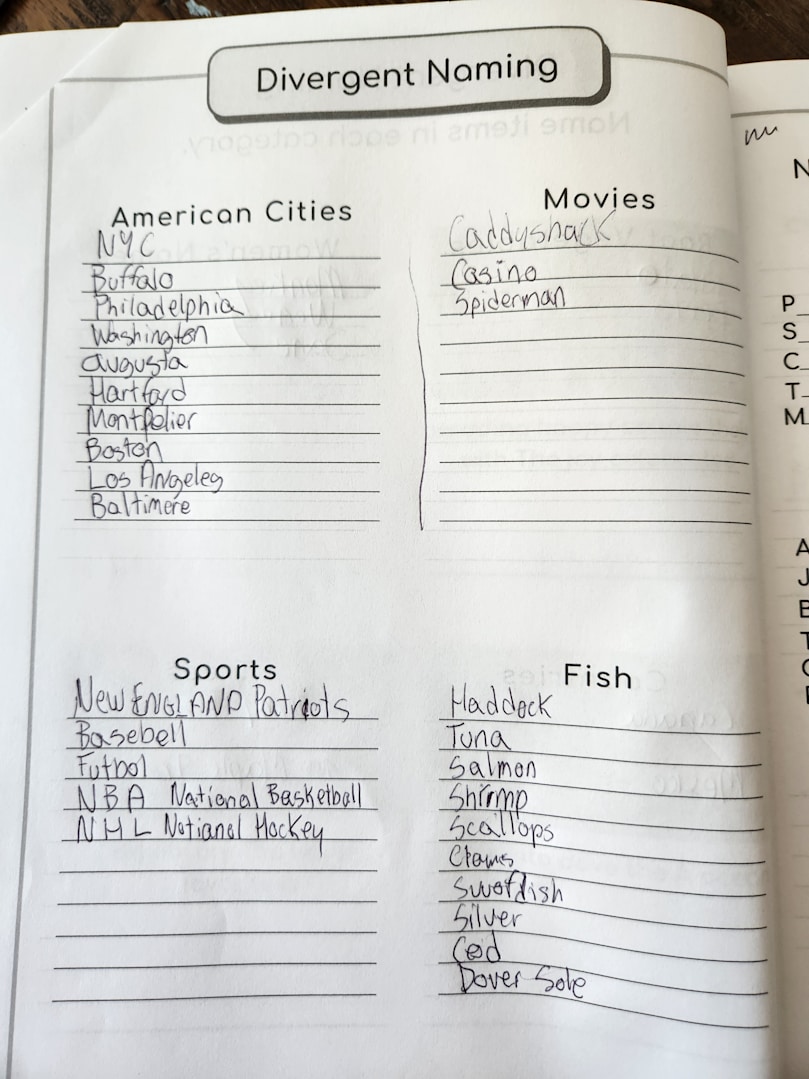
He did very well with three of them.
Then we got to movies.
And he cried again.
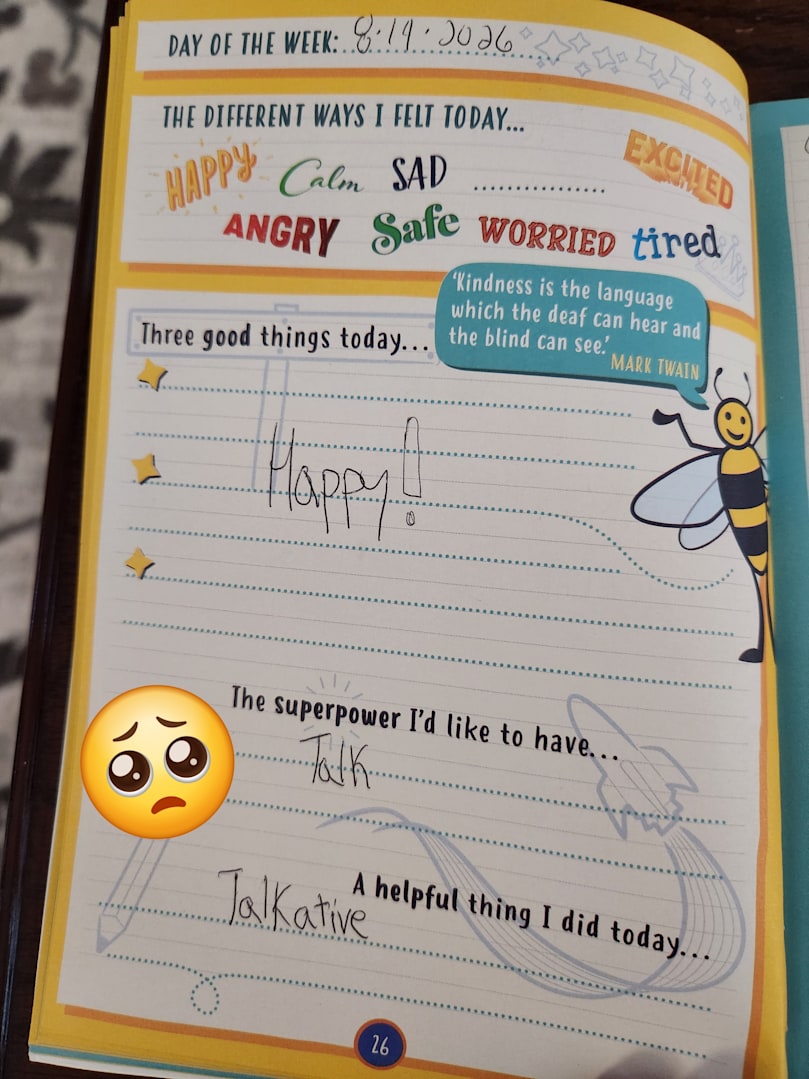
John has always been an encyclopedia of movies. I can never remember the name of an actor, actress, or movie I’ve seen, and John has always been the person who immediately knows exactly what I’m talking about.
Right now, he can’t retrieve those names.
That’s an especially painful loss for him—and a difficult one for me to watch.
I share all of this because there seem to be judgments in every direction about recovery from an injury like this.
He’s doing great.
He’s going to be fine.
You’re pushing him too hard.
Look at him—he looks completely normal.
None of those statements, by itself, describes where we actually are.
John is making progress. And the progress is very, very slow. Both things are true.
I’ve realized that I have a choice. I can keep sharing these updates and grow a thicker skin about the judgments that sometimes come with them, or I can stop sharing altogether.
I’m choosing to keep sharing.
Some of the comments hurt. They make me question myself and sometimes make me feel as though I’m failing him, when every day I’m trying to figure out how much to push, when to stop, when to protect him, and when to encourage him to try again. There isn’t a handbook for this, and I don’t always know whether I’m getting it right.
I can’t ask people not to judge. We’re human. We see a piece of someone else’s life and form an opinion about it. That’s probably always going to happen.
So I’ll work on growing the thicker skin instead.
Because someday, I hope John and I can sit together and read these updates from beginning to end. I hope he’ll be able to see things he doesn’t fully understand or remember right now. And I think he’ll be incredibly proud of how hard he worked and how far he came.
That’s worth writing down.
I just ask people to remember that this is hard for two of us.
And part of understanding how hard it is means understanding what John’s world actually feels like right now.
John can sit in a room while someone talks to him. He can nod. He can say yes or no. He can say, “Yeah, yeah.” From the outside, it can look like a fairly normal conversation.
But that doesn’t necessarily mean he has processed everything that was said.
When you ask John a question, sometimes what he needs most is silence.
Ask the question, and then wait.
Really wait.
Count in your head:
One one-thousand. Two one-thousand. Three one-thousand. Four one-thousand…
Sometimes it can take close to ten seconds for the words to make their way through his brain, for him to understand what was asked, formulate his response, and get something back out.
When people speak at their normal conversational pace—or when two people are talking back and forth around him—he may catch only bits and pieces.
Imagine sitting in a room full of people you love, hearing everyone talking and laughing, and only being able to grab fragments of what they’re saying.
It is incredibly isolating.
Right now, one of the most important things I can do as John’s partner, protector, and champion is give him a place where he feels successful—where people give him the time he needs, where he receives positive reinforcement, and where he can see what he can do without constantly being confronted by everything his brain still cannot.
I know I can’t protect him from the rest of the world forever. Eventually we have to figure out how to navigate friends, family, restaurants, stores, gatherings, and ordinary life with a brain that processes language differently than it did before.
But right now, he is working incredibly hard.
And progress doesn’t always look the way people expect it to.
Sometimes it looks like swimming out to a floating dock in Rockport.
Sometimes it looks like getting 84% on an exercise that would once have been effortless.
Sometimes it looks like crying because you can’t remember the name of a movie you’ve loved for years.
And sometimes it looks like realizing you’re too tired for the dinner you’ve been talking about all day, eating pizza on the back deck instead, and knowing that was enough.


Leave a Reply