It’s been three weeks since my last post.
I was actually thinking about stopping this blog. But recently I heard from a few friends who told me that these updates have been helpful and make them feel connected to John and me. So I thought I should try to keep it up.
Let’s start with the good stuff.
Life is becoming life again.
We’re not in crisis mode anymore. We have routines. We wake up in the morning, have coffee, practice sounds, practice words, and then John works on exercises using Constant Therapy and an apraxia app. Right now, word association, repetition, and individual sounds are some of the most important things we work on.
Speech really does remain the mountain.
One thing I’ve learned about apraxia is that John knows what he wants to say—the problem is getting his brain to correctly plan and coordinate the movements of his mouth, tongue, and lips to produce the sounds. So retraining that motor planning through repetition and neuroplasticity is incredibly important.
Unfortunately, finding a therapist who shares that focus has been harder than I expected.
At Whittier, there was a lot of emphasis on a Lingraphica device, which organizes words and pictures into categories that you navigate through to build what you want to say. As a taxonomist, I love a good hierarchy! But as a communication tool for John, it just doesn’t match how he thinks. If he wants to say “chicken and broccoli,” he doesn’t think: Where is chicken? Food → protein → chicken. Now back out. Where are vegetables? Vegetables → broccoli.
He already knows the words he wants. He wants to say them.
Our newest therapist is also heavily focused on Lingraphica, and we are currently in a three-week trial with the device. I understand why AAC tools are valuable, and Lingraphica also offers type-to-talk functionality. But ironically, John already has much less expensive apps on his iPad that let him do those things.
What we need most is someone willing to keep working on his sounds and motor control.
Because I see progress.
I show John cards now and he can say bubbles, baby, dogs, vacuum, hat, coat, cake—words and even sounds that he simply could not produce a month ago.
Neither of us wants to give up on that. We know this could take a very long time. We’re okay with that. We’re in it together.
So I’ve scheduled a Zoom consultation with yet another speech therapist, this time with very explicit instructions that we want to focus on motor speech and sound production. If the first session goes well, we’ll once again make a change and ask insurance to cover this therapist instead. The nice thing is that John could attend virtually from home, either with me or independently.
We just need to find the person who is willing to work toward his goals.
So what else have we been up to?
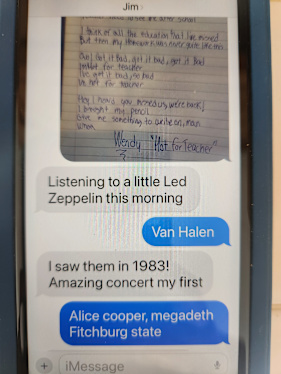
One morning I woke up, came downstairs, and discovered that John had written out (copied) all the lyrics to Van Halen’s “Hot for Teacher” (apparently I’ve still got it!!!)
Then he texted his brother so they could reminisce about a concert they had gone to together.
Those moments mean a lot. He may not be able to sit down and tell me the story out loud the way he once would have, but the story is still there. The memories are still there. And he keeps finding ways to get them out and connect with people.

Two weeks ago, we spent a day and night in Boston. We stayed at the Omni Parker House—the hotel where Boston cream pie was invented—and walked down to the aquarium.

Afterward, John wanted to go to an Irish pub called The Dubliner. We’ve been eating pretty healthfully, so he took out his notebook and wrote something along the lines of: healthy grilled chicken, grilled chicken, grilled chicken, FISH AND CHIPS, GUINNESS—with some very emphatic underlining.
Message received. 😂 So he had his fish and chips and Guinness.
We walked a ton that day and were both exhausted by the end of dinner. We went back to the hotel and took a nap. That evening, I had tickets to a dance performance that I had bought months earlier. John wasn’t interested, so I went by myself.
And sitting there, I realized something: all I wanted to do was go back to the hotel and be with John.
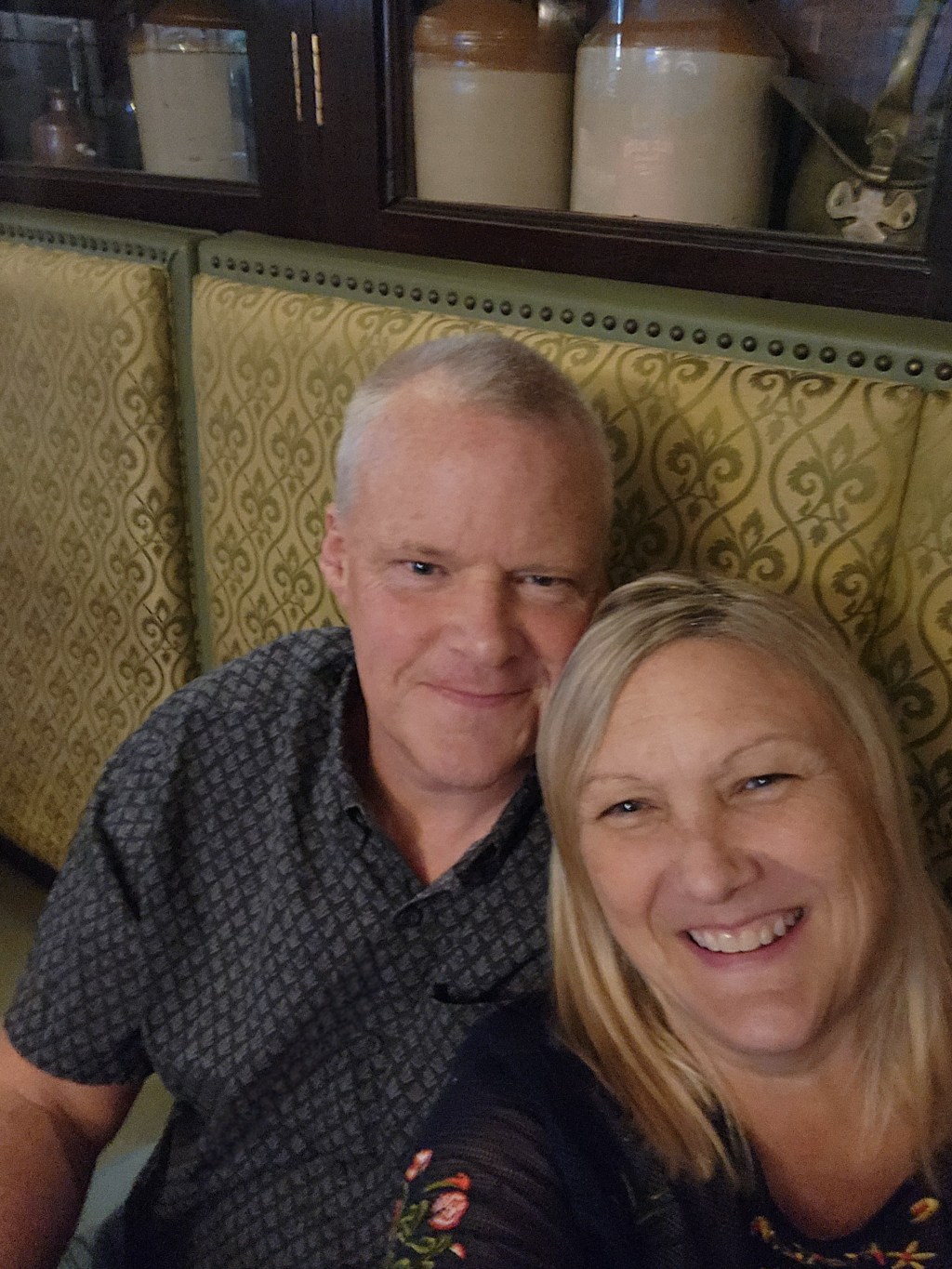
That was such a change from where I had been two months earlier, when I booked the show. Back then, I wanted to run away. I wanted an escape from everything that was happening. By the time this weekend arrived, I wanted him with me.And it was great. We were us. We were a team. We laughed. He shared stories in the ways he can now. We explored Boston together. We had brunch and he got his Boston Cream Pie. It felt “normal.”
I’m changing, too.
Accepting this new role as a caregiver has not come naturally to me.John has always been the caregiver. I’ve always been the fiercely independent one. I go to New York by myself. I go to Australia by myself. I don’t have children. My brain is always going too fast, and patience has never exactly been my defining characteristic.
Now I manage medications. I schedule doctors’ appointments. I watch for changes. I deal with lawyers and insurance. I pay his bills in addition to my own. Sometimes just looking at the pile of mail makes me want to crawl into bed.
But I don’t. I keep going.
And I’m learning patience. I wait while John writes what he wants to say. I put down what I’m doing when he wants to tell me something. I give him time instead of trying to finish the thought for him.
Apparently you can teach an old dog new tricks.
And John is becoming more independent.
The Patriots are back, which makes him very happy. We would LOVE to have people come over and watch games with us. And trust me, you will be well fed.John loves to cook. Last night he made orange-glazed salmon on salt blocks on the grill with roasted golden and red beets. He makes his own chickpea salad. He makes amazing chicken tacos with all the toppings.So seriously—come visit. He needs people.
He has also started driving again, with me in the car, to local places where he knows the route by heart. He does absolutely fine. His neurologist had no concerns about his reflexes, peripheral vision, or the physical mechanics of driving.
The bigger challenges are situations that require communication: going somewhere unfamiliar, dealing with an unexpected problem, or something as simple as being pulled over and needing to explain that he has aphasia. Those are things we’ll continue figuring out over the coming weeks.
We’ve also been making an effort to see people. We visited our sister-in-law Debbie, and we ate bagels with Nonnie in the park while Franklin was being groomed.
And because apparently caregiving wasn’t keeping me busy enough, I built John two little apps: WordWays, to help him practice word associations, and Tell Me, to help him communicate what he wants more easily.
They’re for him—but building them has also helped me keep my own mental and product-development muscles working.
So what’s next?
This week I go back to work. That’s the next big test.
John is worried about me not being here for him. And I worry about him being isolated. Imagine knowing exactly what you want to say but not being able to casually chat with a neighbor or the person standing next to you at the grocery store. That is an enormous loss of everyday human connection.
And I’m worried about the logistics.
Because I work with a team in Australia, my workday often gets heavy 6–10 p.m. John is up around 7 a.m. I may be working until 10 p.m., and my brain often doesn’t shut off until 1 a.m.I worry that I’m going to be 100% spent.
People suggest taking a break in the middle of the day, but that doesn’t really solve the problem. It feels more like working a double shift. My Melbourne teammates are beginning their day, cheery and waking up, while I’m staring at the clock wanting the meetings to end so I can wolf down dinner and get into bed.
I worry that it won’t be sustainable. I worry about what that kind of schedule will do to me physically when I already have so much responsibility outside of work.
But there’s only one way to find out. We try it.
And that is probably the best summary of where we are right now.
John is making progress with his speech. He’s becoming more independent. We’re looking for a therapist who will listen to what he wants to accomplish and help him keep fighting for his speech rather than deciding for him when it’s time to stop trying.
We’re learning how to be a couple again—not just patient and caregiver.
And now we’re taking the next huge step: I’m going back to work, and we’re going to figure out what this version of our life looks like.
Most importantly, we’re trying to make room for joy again.
So please—come see us. Invite us places. Suggest destinations. Give us ideas for things to do. Watch a Patriots game with John. Eat whatever ridiculous feast he decides to cook for you.
We both need people. We both need reasons to get out of this house.
And as we head into this next stage, keep sending us your thoughts, prayers, encouragement, and friendship.
We still have a mountain to climb. But lately, when I look back, I can finally see how far we’ve already come.


Leave a Reply